My Professional Development Plan
District Name: Santa Barbara Unified School District
School Name: Montecito Academy
Teacher Name: Justin Schreiner
Grade Level: 5 - 8th
Goal: Enhance support for 5-8th grade students and promote active student engagement.
Theme: All subjects (including mathematics, English, history, and science).
Performance Standard: TPE 6 - Developing as a Professional Educator
"Reflect on their own teaching practice and level of subject matter and pedagogical knowledge to plan and implement instruction that can improve student learning" (CTC, 2016).
Areas Identified for Development of Professional Practice
1. Development of students' collaboration skills.
Artifact 1 - Morning Sharing Circle
The below artifact maps out our routine for having our “morning sharing.” I like to begin the day together, in a circle, sharing either on a topic I introduce or just a feelings time to share how everyone is doing. In the start of the year, we “make” these circle agreements and then I post them on the wall for the entire year for students to follow and remember their agreements. This helps promote a safe learning environment where students feel secure and are able to share their thoughts and feelings without worry of judgement. Morning Sharing Circle is one example of how I try to provide my students with many opportunities to share to their community and learn communication and discussion strategies.
Rationale:
-
Providing equal opportunity for all students to collaborate instead of just a few students dominating discussions.
-
Students with weaker collaboration skills need more development in proactive learning.
-
Have classroom observations, reviews, and discussions with co-workers and administration to gain feedback.
-
Visual projections of collaboration approaches and correct terminology for students to practice with and use.
2. Integrating technology into the classroom.
Artifact 2: Selfies!
The below artifact shows a fun way that I incorporate technology into the classroom. “Selfies” are pretty popular these days with cell phones at our finger tips. At the start of the year, I take selfies of students dressed up in funny hats and glasses (from the costume box). I post these around the classroom sink and mirror for students to enjoy and laugh. (I had to take down all student pictures because I did not have permission to share with others.) Selfies are just one example of many technological practices that I merge with my classroom and teaching. Our students live in a technological filled era and need to learn skills to survive in the digital world.
Rationale:
-
Gives students the skills to identify and evaluate suitable digital resources to support learning.
-
Helps students spend less time on finding digital resources and websites for assignments by providing appropriate support and teaching safe online research.
-
Makes sure digital resources are focused on learning objectives.
-
Allows students to make projects that use digital programs and resources.
3. Improved classroom management skills.
Artifact 3: Reading Location Chart
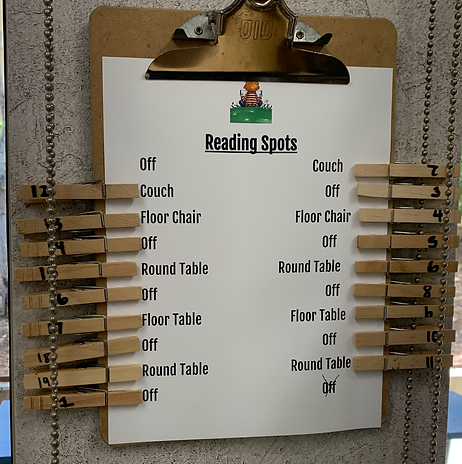
The below artifact represents one way I add to my classroom management. I like to add in components that keep students engaged and focused on the classroom and community. In this example, students are assigned reading spots in the classroom. I use paperclips with student numbers so students know where they need to head when it is individual reading time. I try to offer many enjoyable reading areas and change their reading spots daily. By assigning reading spots, students take control of their learning and have less questions during transition times. Creating daily tasks and jobs for the students helps them focus on their education and gives them less opportunity to be distracted.
Rationale:
-
Use of positive reinforcement. According to TheBehaviorExchange, "Not only is positive reinforcement scientifically proven to increase behavior, it is effective in teaching new and improved behavior, and in doing so, also decreases unwanted behavior. It also is the most ethical choice. Punishment does not teach new behavior, it only focuses on decreasing what is unwanted. Punishment can make the child avoid you whereas reinforcement will likely lead the child to approach you as you become a signal of all the things the child likes. Reinforcement Rules!"
-
Create lessons that touch on student interests and use of manipulative to increase engagement and focus on learning goals.
Reference:
TheBehaviorExchange. (n.d.). What Is the Value of Positive Reinforcement? Retrieved from https://behaviorexchange.com/blog/2013/06/what-is-the-value-of-positive-reinforcement/
4. Increased Student Motivation
Artifact 4: Honor Bucks
The below artifact shows the list of rewards students can “purchase” with their “honor bucks.” Through the day, I pass out fake-1-dollar-honor-bucks to students that are on task, trying hard, helping others, or anything else that deserves acknowledgment. This motivates students to be excellent students and peers to one another, while looking forward to fun rewards! I try to create student motivation through encouragement of hard work, persisting, and integrity.
Rationale:
-
Students excel when given responsibilities and jobs/tasks.
-
Students care for one another and community when they feel involved and part of the group.
-
Students' personalities and leadership abilities grow under controlled motivation and support.